Word hunter [The Bangkok Post, 15 May 2001]

Homepage

A master of language and a sponge for culture, Marcel Barang occupies a unique position as a translator of Thai literature, and has a passion to let the world know all about it 

Story by Wanphen Sreshthaputra

Picture by Somkit Chaijitvanit

Marcel Barang, Thailand's unique

Thai to English and Thai

to French literary translator,

relaxes in a park. 


'This is a book of the first rank, a masterpiece, a fine piece of literature!" exclaim some people with admiration.  

"This is filth, trash... The writer is low-life scum!" retort others.  

From a distance of tens of thousands of kilometres and through different media in different languages, a fascinating game of literary ping-pong is being played.  

A battle of wits, or rather a verbal sparring match which is a delight to one who has observed all sides; Marcel Barang, Thailand's unique Thai-English/Thai-French literary translator, thanks to whom this unprecedented confrontation has unfolded. 

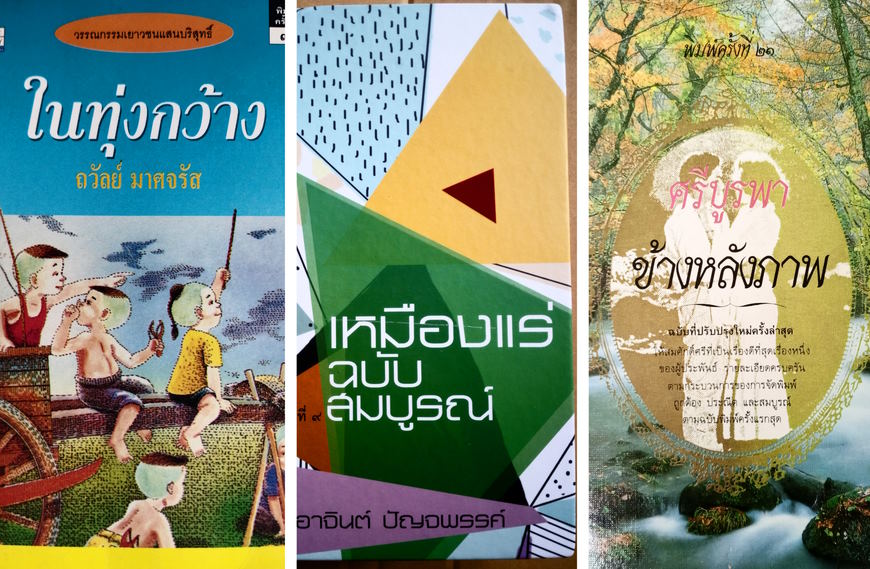
The matter in hot debate? Saneh Sangsuk's novel Ngao See Khao (The White Shadow) written under the pen name of Daen-aran Saengthong, released in Thailand in 1994 to a public outcry.  

Conversely, the book's French version entitled L'ombre blanche (Les Editions du Seuil) was published in early January 2001 and foreign critics are effusive in their praise. 

 Top

"This hefty tome of 500 pages-to be read while holding one's breath as it is a succession of 40-page chapters without any paragraph marks-deserves straight out the qualifying term of 'masterpiece'... The story-a unique exploration of a Thai society tuned into violent sexual urges-is enough to make you gasp ... Contrary to a certain kind of Asian literature in fashion at the moment in which an exotic locale is a passport to glory-L'ombre blanche_ embraces the universal; its internal landscapes, characters' soul..." asserts Bangkok-based correspondent for Le Point, Philippe Latour, in this month's issue of Gavroche magazine. 

But whether Ngao See Khao is indeed a masterpiece "whose writing is highly poetic and completely original and compelling" or not; whether or not it is "to modern-day Thailand what Ulysses was to James Joyce's early 20th century Europe; a pioneer, seminal work," wrote Marcel Barang in a previous issue of Puchadkan (Manager) newspaper, whether or not Saneh is a devil or, as Barang bets "the upcoming master novelist of his generation," is actually quite another story. 

The focus of our story is the "literary crazy farang" as he describes himself, a juggler of many languages, cultures and ways of thinking who has contributed to an exciting peak on a rather flat Thai literary landscape. 

"This slow-reading farang has been mad enough to spend, to his own surprise, some 70 hours over six days reading with pen in hand this single volume and ending this unbelievably pleasurable torture craving more of the same, and he is mad enough to be fully convinced that, despite its shortcomings, this enormous piece of fiction qualifies as one of the very best Thai novels ever published, whether or not the Thai readership will accept it."  

French-born Barang ironically hammers it in.  

But if Barang is indeed "mad", the mental health of many foreign literary critics and publishing house editors is also to be challenged. "They swore straight away it was a masterpiece," specifies Barang, who exults: "I am not the only mad man around!" 

Of course the chances that one questions his mental soundness are inversely proportional to the translator's well-proven experience and acknowledged talent.  

A resident of Thailand for the past 23 years, this tall and stern-looking farang describes himself as the only professional literature translator of Thai language in the world, handling with the same ease, finesse and sophistication, French (his mother tongue), English and Thai. Like a word wizard, he enthusiastically locks himself into someone else's thoughts to relay for other eyes to see-non-Thai eyes that is. 

"I am cut out for this kind of work. I really found myself when I started translating Thai literature," comments Barang, whose favourite Thai novelists are Chart Korpjitti (Mad Dogs & Co, The Judgement)-"always coming up with top level novels"_ and obviously Saneh Sangsuk. 

"I define myself by the work I do," he states, adding: "I tend to appreciate the English language more. I find it more fluid and flexible than French, which can be very heavy sometimes. 

"The quality of a translator's work depends on his expertise in the language he is using. Translating Thai requires a working knowledge of Thai and all its nuances. A literary translator needs a high level of sophistication in his handling of the language as much as a writer," Barang explains resolutely.  

Barang's love affair with Thai literature actually started in late 1992 when, after an altercation with his employer, Barang was left to himself and a somewhat idle life. "Being a workaholic, I couldn't bear it," Barang remembers. It was then that he started to test his skills in translating literature. 

 Top

Like an oyster clamming up, Barang dug for his own internal treasures and resurfaced with a pearl-a cultured pearl if we can put it that way-to launch a collection of the best examples of 20th century Thai literature; the Thai Modern Classics series as it would be known. 

With his personal crisis behind him and the sun shining brightly in the economic sky, his then boss-the enterprising Sondhi Limthongkul of the Manager group-readily supported him in this prestigious venture. 

"The fairy tale about it is that when I started this project I had actually never read a Thai novel in full," admits Barang who, with the help of a dozen of Thai literature experts, started to establish a selection of the best Thai novels, narrowing down the list to 99 titles to be found and read. 

"Within two years or so, I assessed some 300 novels. I had a rule that if after reading the first 100 pages I was still not hooked, I would give up," explains Barang. In turn, he produced an anthology entitled The 20 Best Novels of Thailand, which provided a broad picture of the Thai literary scene, ranging from Arkatdamkeung Rapheephat's Circus of Life( 1929) to Daenaran Saengthong's White Shadow (1994). 

But the economic crisis of 1997 was soon to cause chaos for this noble enterprise. With the Manager group imploding, the series was stalled in mid-stream and remains unfinished. Once again, the workaholic and literature-crazy Barang had to take it upon himself to find a way out. 

"When my days in Thailand were numbered, I wrote a letter to His Majesty the King explaining that I wanted to carry on my project, that I was uniquely qualified to do it and how important it was for Thai literature to be known abroad, but that my visa was soon expiring.  

"His Majesty probably never read my letter but his secretary did. The late MR Bhirabongse Kasemsri, himself a great translator of Thai poetry into English, called me. Although he said there was no money available for such an enterprise, he arranged my visa in no time and appointed me editorial adviser to the National Identity Bureau under the Prime Minister's Office." 

Since then, the prolific translator has managed to survive with small jobs, leaving him sufficient time to indulge in his passion. "I started out during the golden era of Thai economic growth but I soon found out it was impossible to survive on a translator's wage," explains Barang, who at present is still struggling to make ends meet but wouldn't part with his vocation for anything in the world. 

And, the 56 year-old former language and art teacher-cum-journalist-cum translator has never taken pleasure in an easy life and seems accustomed to fighting for what he wants. "Actually I am in my third existence," explains the chain-smoking Barang.  

A native of the South of France, Barang first entered the work force as a teacher of French, English and Fine Arts in Cambodia for a period of two years in the late '60s, while serving as volunteer of the French national service. But it didn't take him long to realise that teaching wouldn't be his lifelong path.  

Back on French soil, Barang switched to journalism and soon specialised in issues related to the Southeast Asian region, from Paris and later on from London, assigned to Reuters' French desk. 

But never doing things by halves, Barang soon steered to the other side of the world, intrigued by Southeast Asia, determined to "always learn the language of the country he would settle in". Choosing a country in the region in question "where the language would be very easy to learn", he decided on Indonesia. 

As fate would have it, Barang never reached his planned destination. After Singapore and Hong Kong-with a short stop in Jakarta five years after his departure from Europe-the journalist finally unpacked his suitcases in Thailand on May 12, 1978.  

A quarter of a century later he is still here, with a Thai wife and a 14-year old daughter. His first investment in meticulously learning the local language has been profitable, as did his perseverance in freelancing for both French and English newspapers.  

"There is no way a farang can really blend although life here has become easy. I cannot become a Thai. It would be foolish to say that I am not what I look like," Barang said.  

"My feelings and temper are not Thai at all, neither are they particularly French. Let's just say I feel white."


 Top

Thai Fiction in Translation