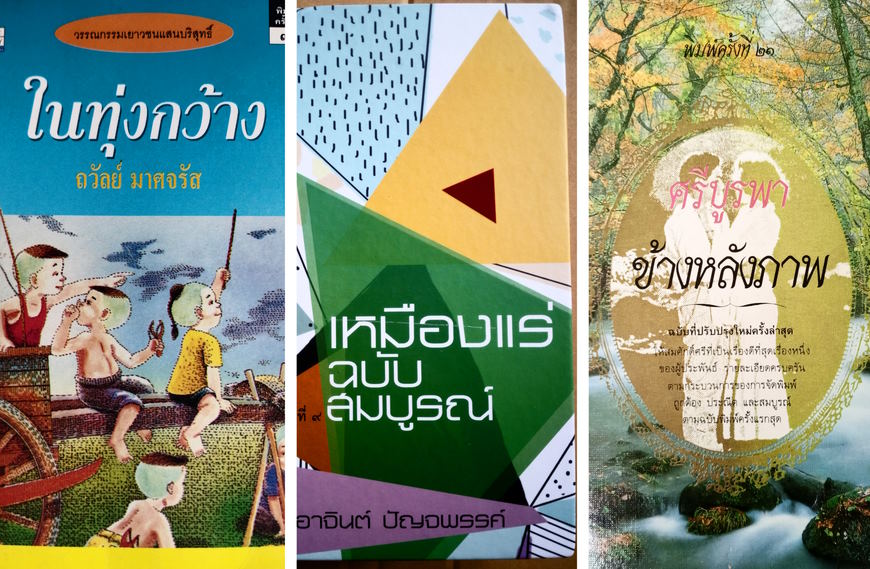
the twenty best novels of thailand
An anthology by Marcel Barang
To Khun Khroo Buaphan,
who tutored my stuttering totter into Thai,
and to Mary R Haas, S Seitthabut [So Sethaputra],
Damnern–Sathianphong [Domnern–Sathienpong]
and Wit Thiangbooranatham [Thiengburanathum],
authors of the best Thai-English dictionaries,
for services rendered day after day.
This book, and
the whole programme of literary rebirth it heralds, would not exist without the
foresight and generosity of Sonthi Limthongkun [Sondhi Limthongkul], head
of The M Group in Bangkok and sole sponsor of Thai
Modern Classics. We both hope that this long-term undertaking will
benefit not merely a group of outstanding Thai novelists but the whole nation.
To Sonthi, my employer, nemesis and friend, my most heartfelt thanks for his
unstinting support and complete lack of interference.
In finding my way through the maze of Thai novels, I received
precious assistance from ten experts who were kind enough to handpick the best
Thai novels for me to assess: Chaisiri Samutawa-nit, Chamaiphorn
Saengkrajang, Chananao Waranyoo [Varanyou], Darranee Mueangma [Daranee
Muangma], Khamnoon Sitthisamarn, Seiksan Prasertkun [Seksan Prasertkul],
Suchart Sawatsee, Thaneit Weitpharda, Tharnthip Kaeothip [Dharntipaya
Kaotipa-ya] and Treesin Bunkhajorn. To all I feel deeply indebted.
Chamaiphorn, Seiksan, Thaneit and Treesin, as well as Nopphorn Suwanapharnit
and Witsanu Cholitkun, lent us rare books and deserve special thanks.
I am thankful as well to the eighteen authors or their legal beneficiaries
for allowing me to translate excerpts of their works for this anthology, as a
prelude to a complete rendering of the novels in English. Their kind words of
encouragement have made me feel we are on the right track. Regrettably,
however, Khuekrit Prarmoat [Kukrit Pramoj] has forbidden us to translate his
novel See Phaendin.
Throughout the writing of this book, I received invaluable advice
from Phongdeit Jiangphatthana-kit, who corrected my countless mistakes in
translation, assisted in the writing of some chapters and generally acted as
an able and caring interpreter of his culture. He and Montree Phoome, the
project’s logistics manager and a short-story writer in his own right, were my
first sounding boards.
Thomas A Wingfield and Clare L Griffiths in London gave the text its
final polish, and their corrections and suggestions were priceless. Be they all
thanked here and share in whatever praise this book may earn. Of course, I am
the only one responsible for the book’s shortcomings.
Finally, I would like to thank my life companion, Orn-anong Sa-artphak,
and our daughter, Orramart Aurore, for putting up for so many long months with
an absentee lover and dad.
MBg
Thai, a language
with five tones, has no generally accepted system of transliteration. Most
systems in use follow the conventions of written Thai, which leads to mispronunciation
of a great many words – a most deplorable state of affairs when it comes
to names of places and people. To give non-Thai readers a chance to pronounce
Thai words almost correctly, Thai Modern
Classics has adopted a transcription code based solely on
pronunciation, ignoring, however, the all-important tones – only an adaptation
of the international phonetics system, which itself is too complicated for
the average reader, would take care of tones satisfactorily.
Pali or Sanskrit words such as ‘Dharma’ or ‘Buddha’ will not be
transliterated, unless they are part of a Thai phrase. The words ‘Siam’,
‘Bangkok’ and ‘Baht’ (the Thai monetary unit), of current use in English, will
be transliterated as Sayarm, Bangkork and bart in Thai
phrases.
Whenever we are aware of it, the official spelling of place names and
preferred spelling of people’s names will follow our transcription in square
brackets on first appearance: for example, Theiweit [Dheves] and Khuekrit
Prarmoat [Kukrit Pramoj].
The basic elements of transcription are as follows:
• all consonants
are the same as in English, except k, p and t, to which h is added to
distinguish the hard sound (the standard English k, p and t sounds) from the
soft sound (the standard k, p and t sounds of most other European and Romanised
Asian languages); Thai has no v sound: we use w (ie, Sukhumwit);
• vowel sounds
are as follows: a as in pat; ar as in far; e as in the or
as in bed or as in the French word et; eu as in the French word peu;
eur as in fir; ei as in grey; ae as in bear; i as in hit;
ee as in heat; o as in hot or as in the French word haut;
oa or o- as in own; or as in or; u as in pudding; oo as in
good;
• ai as in bite
or fly [short and long]; ao as in pout or now [short and
long]; eui as in the French word œil; ia as in fear; oi as in boy;
ua as in tour; uay as in gooey;
• the Thai
sounds ue (a short, strangled ugh!), uer (same, but longer), uey and uea have
no equivalent in European languages;
• to lengthen a,
o and e sounds, r is added to the vowel, except when the vowel is at the end of
a word: narna but sapharn;
• r is replaced
by a hyphen in the case of wa- to avoid the ‘o’ sound of ‘war’ (and by h
in the name Waht for the same reason); r is left out when there is a
double consonant at the end of a syllable (hence, bang, not barng);
• finally, in
rare cases of words ending with a short, open ‘o’ sound (hot), h is used after
a vowel to distinguish it from the other ‘o’ sound (memo): for example, phroh.
thai titles of royalty and nobility
part one
sunthorn phoo, the people’s poet
in the darkness before dawn...
part two
To present “the twenty best novels” of any
European country or even of a relatively young nation such as the United States
would be preposterous. To select “the twenty best novels of Thailand” arguably
is not. The novel in Thailand is a recent western import; the first truly Thai
novels were written only seventy years ago. The body of available work is
relatively small, a few thousand volumes, the bulk of which were scribbled to
offer (very) light entertainment* and can
be dismissed outright. Sorry to say, Thai novels of high literary octane number
only in the hundreds.
I have
endeavoured to select the best twenty, out of a first selection of a hundred
provided to me by ten “professional readers” (professors of literature,
literary critics, writers) and from my own reading, which was guided by the
novels featured in various manuals of literature and literary criticism written
in Thai, English or French. I also read most of the novels written by each of
the eighteen authors selected, to check the validity of the selection and
understand the evolution of each writer, as well as most of the novels published
since our project started in January 1993.
The
choice of Thai literary experts was both deliberate and happenstance. I asked
for and received the help of several recognised authorities in the field of
literature – and I do apologise to those I failed to identify due to ignorance
on my part at the time. A few university professors of literature attending a
seminar on translation of Thai short stories organised by linguistic activists
from the cultural team of the French embassy were also kind enough to forward
their own contributions. The eclectic choice of these women was substantially
different from that of the acknowledged experts in that it strongly favoured
female romance writers of popular appeal, whose novels came to account for a
good third of the hundred titles first selected.
I
assessed all the novels which were recommended, as well as about another
hundred novels. By assessing the novels, I mean that I read them as
discriminatingly as I could, with the rule that, no matter how dull or lame
they would turn out to be, I would read a minimum of one hundred pages. If,
within one hundred pages, a novel is unable to show its mettle, capture and
hold the reader’s attention, then why bother with it. And so it was that I read
about two thirds of all the novels from start to finish, even though in too
many cases it was merely to see how the disaster would end.
To my
distress, I found it easy to discard a great many works, even among those
recommended by more than one expert. The reasons, I believe, had less to do
with personal talent than with the lack of a proper literary environment. Too
many seasoned Thai novelists make beginner’s mistakes. Put bluntly, from a
literary-minded foreigner’s point of view, no more than fifty Thai novels of
any genre or period qualify as flawless classics to be read by this and future
generations for pleasure and intellectual profit, as distinct from yarns that
are leafed through to kill time or perused out of academic or otherwise specialised
interest.
With the
aim of selecting the very best Thai novels, not merely the good ones, in order
to translate them into English over the next few years – the raison d’être of
the Thai Modern Classics
programme – I trimmed the list down to twenty titles. Why twenty rather than
ten or thirty? Because I decided to make the selection broad but to keep it of
manageable size – and also because I am not sure I could find an extra
ten titles I would care to translate.
I have
tried to choose independently of my own tastes. Among the novels selected, I
have a few favourites, and a few others are not entirely to my liking.
Nevertheless, the critic in me believes that all are outstanding and definitely
worth translating for the world to read. I am not naive or cocky enough,
though, to profess that mine is the definitive choice, because, in the final
analysis, there is no such thing: objectivity, like perfection, is an aim man
tries to approach but never reaches. Personal taste aside, one’s choice is
valid only to the extent of one’s own knowledge and sensibilities. Discriminate
reading, like literary criticism, is an exercise at once objective – observing
the various elements of a tale like a mechanic takes apart a car engine – and
subjective: keeping attuned to feelings, musings and undercurrents as imponderable
as the music of the spheres. To the extent that subjectivity is involved,
these are indeed “the twenty best novels of Thailand” according to Marcel
Barang.
The basic
literary criteria that guided my choice are familiar to most western readers
but still appear to elude many Thai readers, writers and even critics. These
criteria are strictly literary, not political or moral. Politics and morals
have their own media. Propaganda and zealotry are the death of fiction. A novel
may well preach social revolution or salvation of the soul (or damnation or
conservatism, for that matter) but it is neither a poster nor a pulpit and
should not be assessed as such. To measure literature with moral or political
yardsticks is more than irrelevant – it is misguided and harmful.
The first criterion is quality of language, by
which I mean not merely correct syntax and precise semantics (you’d be surprised,
even by some of the best pens!), but more importantly style, a certain way
with words that enchants, tickles or stuns and creates by its very magic a
world of its own, complete and unique.
A novel
is a work of art crafted with words only, to which sloppy syntax or pedestrian
prose are terminal diseases; prosaic language, pest; euphuism, cholera. Style
is a rare gift that knows neither sex nor social origin. Some of the best
stylists in the kingdom are women writers, who, alas, waste their talent in
otherwise insipid yarns that tabulate heartbeats and propound lofty views about
dripping faucets. Elegance of the pen is neither a prerogative of the aristocracy
(indeed the best Thai writers these days belong to the middle class) nor a
matter of high-sounding phrases and big words. If the tone and context are
right, there is nothing wrong with slang terms or swearwords – the froth of the
language broth – and nothing wrong either with newly coined words that
make sense, if used sparingly. In any case, good style of whatever grace –
smooth or crunchy, spicy or fragrant, earthy or ethereal, baroque or terse,
jazzy, funky, racy or classic – is a sine qua non for good fiction.
With one
of the most musical and subtle languages on earth, and centuries of popular and
courtly juggling with words, Thai writers have an innate feel for the phrase
that flows (too much or too fast sometimes), and hundreds of Thai novels would
qualify in terms of style, but the trouble is, too many qualify on that count
only.
The second criterion is internal coherence, the
difficult balance between form and content and between the various components
of the work. A novel is a story (plot) told by means of description (of things,
places, people), narration and dialogue (or monologue). In mixing these
elements, there is no set recipe, and creative writing consists precisely in
coming up with new organic blends, in which the total is more than the sum of
its parts. That “more” is the literary charge; the greater the charge, the
greater the novel. If the total is equal or nearly equal to the sum of its
parts, then forget it, the novel is a waste of time.
Plots
provide plenty of occasions to flounder. A plot can be strong and gripping or
weak and potentially boring, but it must be coherent: you cannot launch a story
in one direction only to change course and start all over again (unless this
keeps recurring as part of a clear pattern which eventually tells a different
tale altogether); or ditch the hero or heroin way before the end (unless it
happens to be a family saga in which new heroes take over as a matter of course);
or build one half in a smooth blend of fictitious elements only to cram the
other half with official documents, newspaper clippings and the like, stalling
the action and smothering the characters. Authors can get away with the most
outrageous views if they manage to blend them with the narrative, but to
interrupt the action with solid chapters expounding even the most cogent
thoughts or with side plots of little or no relevance to the main course are
sure ways to kill the balance of a novel: these adjuncts stick out like sore
thumbs, and do indeed rate thumbs down.
In
telling a story, the pace, whether slow or fast, must be sustained – although
the slower the pace, the more likely the reader will be bored, which definitely
happens every time a plot gets sluggish or stalls.
Settings
and characters also must be coherent, both within the story – how consistent
are they? how indispensable to the plot? – and by comparison to the real world:
are they lifelike? are they believable? Only a mad character may behave in an
erratic manner: it is expected of him; when a sane one does, the reader is
shocked unless he is told why, or at least forewarned. That people in real life
do behave erratically all the time is no excuse: verisimilitude, the stuff of
fiction, is not truth, merely its appearance; happenstance is part of real
life, yet artificial in fiction if unannounced. It is the author’s job to make
the erratic, the fortuitous, the incongruous plausible. A man who does not
believe in spirits yet wakes up one morning as a medium is not credible
without some sort of explanation or warning. Endings sometimes ruin very good
yarns, when for the sake of a final fillip, the hero is made to do the opposite
of what, on the evidence of the rest of the story, he must do.
A novel
is an exercise in make believe which presents not the real world but a world
that could be real – complex, lively, three-dimensional. Not all novels are
realistic in treatment but all, even the most ethereal, must be grounded in
hard fact to be at all credible. Without a realistic base, the most wonderful
flight of fancy won’t take off. Ghosts need houses to haunt, and the closer
they come to your bedroom, the better they scare you; so, let’s see the bedroom
first, and hear the floor creak. Even magical realism, so fashionable these
days, starts from a recreation of the real world before magic takes over.
Stream of consciousness, automatic writing and other hip writing techniques
make for exciting pyrotechnics but they become gratuitous exercises if they are
not harnessed to a realistic frame of reference – something the proponents of
art for art’s sake never seem to grasp.
Too many
Thai novels, I found, are dripping with honey and rosy beyond belief. There are
cultural and ideological reasons for this. Thai culture is non-confrontational
in essence and, for the sake of social harmony, the Thai will always try to see
only the “good side” of things and feign to ignore problems as long as they
can: this works to some extent in real life, but applied to the novel, it means
fatal blandness.
Countless
romances fall into this credibility trap, as do most autobiographical works
recalling early youth out on the farm or up on the range. Besides being usually
plot-less, these recollections of days past are so full of nice souls caught up
in petty dramas that they end up sounding at once rosy, drab and trite.
Furthermore, politically minded writers left and right tend to create heroes
that are truly out of this world. When a hundred radical students are locked up
in a tiny cell for a month over two hundred pages and not one of them goes mad
at his sweaty and stinking fellow inmates, we are indeed in the presence of
saints or angels, not of full-blooded young men. When every ten pages or so the
protagonist of a novel swears dedication to Duty and praises Nation, Religion
and King, we yawn and close the book. In this type of crusading literature,
angels are wont to confront devils and heroes to tackle villains – where are
the real men? Novels should never be studies in black and white, but as
multicoloured as life itself. For all their good intentions and bleeding
hearts, the disembodied zombies of most “literature for life” offerings are
less believable than ET or Mickey Mouse, and a lot less endearing.
The same
principle of coherence and verisimilitude applies to dialogue, which is a
paramount device to enliven a tale, speed the action along and give depth to
the characters involved. If there is nothing more dreary than contrived
conversations, and nothing more exhilarating than spirited ones, too much of
even excellent dialogue is not such a good idea, as you end up with a hamburger
without beef – a play or film script rather than a novel.
As for
specialised knowledge, too little is just as bad as too much. A novel involving
lawyers should explain the law and court proceedings well enough to have us
rooted to the bench until the trial ends, yet nobody wants to read the civil
code chapter and verse. However well written, the exchange of blows between
kick boxers over dozens of pages will thrill but the most dedicated fans, and
all but cultured cattlemen will enjoy an offering of a thousand and one tips on
how to raise buffalos.
The third criterion is vision, meaning both scope and originality. Scope
applies not only outward as a macroscopic view of society revealing the
breadth, depth and specificity of a fictional world, but also inward, as a
microscopic study of the self exploring the depth and complexity of man. The
world outside and the world within are both legitimate raw material for
fiction, and as in life are best combined – which is why the art for life–art
for art’s sake debate is so debilitating, impoverishing fiction by
oversimplifying and setting up fences where there should be none.
The
greatest works of fiction change your perception of the world and of yourself.
They may not have great numbers of characters, cover huge geographic or
historical grounds, or depict outstanding events such as war or epidemics:
great literature is not a question of numbers or bulk; it is merely a matter of
sharpness and originality of vision, reaching far out there for the truths and
ways of the world as well as deep inside for the lies and emotions of man.
Each generation
begets a few novels that seem to encapsulate the perceptions of the times, but
these works only last if they remain relevant to later generations by offering
them values common to all of mankind: you do not keep reading Cervantes,
Richardson, Tolstoy, Balzac and all the other greats for what they tell you of
their times but for what they tell you about yourself. Too many novels, though
magnificently written and expertly balanced, lack scope and intellectual
seasoning. They feel hollow and flat. Once you have read them, you are none the
wiser and wonder what all the fuss was about.
The last criterion, specific to this undertaking, is international compatibility. None of the novels
selected is culture specific. Even though some of them have an important Thai
cultural dimension, this Thai texture can be translated, with the help of the
odd footnote, in such a way that foreign readers can still relate to the
stories without missing a quiver of the local bamboo mouth organ (notice I
didn’t write khaen).
There is,
however, a small body of very good but culture-specific novels which defy
translation or even transposition and which I had to reject. This is the case
for example of “Bunluea” ’s Suratnaree, published in 1971, a fantasy
which tells of an island-state in which women hold power and men are relegated
to women’s traditional duties save child-bearing. To readers familiar with Thai
cultural mores, it is a very funny, thought-provoking satire of male-dominated
society, but it would be meaningless to outsiders without a surfeit of learned
footnotes which would spoil reading pleasure.
Another
example is Jao Jan Phom Horm, which I would translate as “Lady Jane of
the fragrant mane” to respect the spirit if not the letter of the title.
Written by “Marla Khamjan” [Mala Kamchan] and crowned by the 1991 SEA Write* award, this short but difficult novel written in sonorous prose tells
the story of a northern Thai princess who makes a pilgrimage through the jungle
to Burma’s Golden Rock to decide which of her two lovers she will betroth. This
highly literary exercise is written in a mixture of Thai and northern Thai
dialect (the text is littered with linguistic footnotes) and all along plays on
central and northern Thai myths and legends. This amazing cultural maze defies
transposition in another language – though I understand one learned daredevil
is attempting a French version of it*.
The twenty novels presented here are extremely
varied in form, content, atmosphere and import, and by and large mirror the
richness and ebullience of the Thai novel, which is still in its adolescence.
The first
part of the anthology provides a bird’s-eye view of today’s literary
environment – or rather lack thereof – as well as a brief presentation of
Thai classical literature and of each of the twenty novels, from a social,
political and literary perspective. Fiction is not produced in a vacuum: every
novel is a result of and contribution to literary history and has its own way
of reflecting both the personality of the author and socio-political realities
at the time of writing.
To write
a comprehensive history of the Thai novel was not my purpose. There are dozens
of minor masters out there whose novels would be instructive to appraise and
take apart; some writers have had an influence in the world of letters out of
proportion with the quality of their works; literary schools and groups have
come and gone, not necessarily in step with historical changes – but to record
all this in some detail would have meant at least another tome, which might not
be of great interest outside of Thai studies.
It was
only once I was done selecting and putting these novels into perspective that I
was struck by two facts: one is that a whole generation of good novelists has
gone missing. I did not engineer the disappearance or rather the literary
mediocrity of authors born between 1921 and the end of the Second World War – a
string of “paternalist” field marshals saw to that, so much the pity. Maybe
there is a lesson here for all to ponder. The other is that, contrary to a
fashionable feeling in Thai literary circles these days, the contemporary novel
is neither dead nor moribund: nine major works have been born in the last
fourteen years, appearing almost on a yearly basis, and there is no compelling
reason to fear that the well is about to dry up.
The
second part of the anthology presents each of the twenty novels, with a brief
biography of the author, a summary of the plot laced with short extracts to
wet readers’ appetites, and a brief critical assessment of each work to show
its social relevance, main strengths and shortcomings. In writing the
biographies of dead novelists, I have had to depend on existing documentation,
which is abundant on celebrated authors but scarce and vague on others who have
long been ignored or neglected. Hence differences in treatment which are all
too obvious and regrettable.
The two
parts of this anthology can be read independently, as can each book section
in the second part. So do browse around by all means! As this is not an
academic work, I have dispensed with a bibliography, but all the books I have
found useful are duly mentioned in footnotes. The back issues of two defunct
literary magazines, Loak Nangsue (Book world) and Thanon Nangsue (Book
lane), and of one ongoing one, Writer Magazine, have been of particular
use, including as a source of most of the photographic portraits of writers on
which the sketches illustrating this book are based.
The
translation of all the excerpts are my own, except one, “Nikhom Raiyawa”
[Rayawa]’s High banks heavy logs (Taling Soong Sung Nak), for
which I used and very slightly edited Richard Laird’s excellent version*.
This
brings me to the sorry topic of translation into English
– not to mention other languages I know nothing about, such as German and
Japanese, which seem to have welcomed a greater body of Thai fiction than
English.
Thai literature, and more specifically the Thai
novel, has been very unlucky in terms of exposure to the outside world. Despite
the massive presence of Westerners on Thai soil for the past forty years or so,
few have become fluent enough in the vernacular to read Thai fiction with
discerning pleasure and fewer still have felt the need to share their
enthusiasm with fellow English speakers.
As a
result, besides a handful of collections of short stories, less than ten novels
have ever been translated into English. It is only in recent years that two
good translations of excellent novels have seen the light of day*. As for
the rest, either the novels that were well translated were far from outstanding** or those
that were outstanding were maimed in translation***. At the
time, the few thousand expatriates who were able to lay their hands on these
English versions were so grateful that they existed at all that they closed
their eyes to their shortcomings, but the world at large may be forgiven for
thinking that there is no such thing as good Thai literature.
By
publishing accurate literary translations of Thailand’s top twenty novels, Thai Modern Classics hopes to change
such a perception.
Because
these translations are meant to be read primarily for enjoyment by people who
may not even know where Thailand is located – left of Vietnam, man, below
China’s paunch – I have opted to use as few words in Thai as possible and keep
footnotes to the bare minimum. These novels are rich enough in local colour
without having to doll them up with allegedly untranslatable terms for cheap
effect unmeant by the author. So, words used to designate people (ai, ee,
yai, noo, phor, mae, phee, nong and
the like), which are so much part of the way the Thai express themselves but
tell nothing to outsiders, have been and will be deleted as a matter of course
(or translated in a roundabout way whenever possible), and titles of nobility
will be translated with rough equivalents on an ad hoc basis.
Thai
titles of royalty and nobility
Thai royal
lineage fades out over five or four generations, from Jaofa (Crown
Prince[ss], child of a king) and Phra Ong Jao (child of a king born of a
minor wife or concubine; also, child of a Jao Fa, hence grandchild of a
king), Morm Jao (child of a Phra Ong Jao [Mom Chao or MC])
to Morm Rarchawong (MR) and Morm Luang (ML). Future generations
are allowed to add na ... (na Ayutthaya, na Songkhla...) to their surname
to denote royal origins. All of the above titles translate as Prince or
Princess. The children of a prince and a commoner (addressed as Morm)
lose one rank.
Titles of nobility, which were created in the mid-15th century,
were abolished in 1932. They were, by descending order of importance: Jao
Phraya, Phraya, Phra, Luang, Khun, Muern, Phan and Thanai. Rough
European equivalents would be Duke, Marquess, Earl or Count, Viscount, Baron,
Baronet and Knight. These titles were bestowed according to the importance of
the administrative office held. Unlike European feudal titles, they were not
hereditary and could be revoked at the king’s pleasure. All titles came with
land, 8 000 acres for a prince, 4 000 for a Jao Phraya, down to 10 acres
for a commoner. At the end of the 19th century, government officials began
receiving salaries instead of land.
Literary translation is a difficult exercise demanding probity and
modesty on top of a good command of both languages involved. Traduttore,
traditore. The Italians got it right: the translator is a traitor; to
translate is to betray – to betray words and phrases in one language for
different phrases and words in another, in the name of the higher loyalty due
to the original meaning and to the original style. Each language has its own
genius, its own way of composing a sentence, its own idioms, colloquialisms,
etc, and a certain amount of grammatical and syntactic manipulation is inevitable
to achieve a fair transmutation. But there are limits to what a translator is
allowed to do, as his paramount task is to stick to the original as much as
possible. Literary translation is not a mere question of rendering the meaning
accurately, as for any official or commercial document: it is also a crucial
question of style. Real writers are style-conscious and agonise over the
right word and the right rhythm, and they are entitled to a faithful rendition,
which seldom goes word-for-word, of course, but should not extend to the
complete rewriting some translators try to pass off as “creative” translation.
The only
creativity I know in translation is in sticking to the original phrasing as
much as possible and yet managing to produce a text that flows like the
original but does not sound translated – that does not smell of milk and
butter, as the Thai say. It is a craftsman’s labour of love, not the
legerdemain of a failed creator squatting over someone else’s text. And it is
the only approach that allows not just the tough yet manageable performance of
one translator translating one novel with one style but the damn near impossible
exploit of one translator translating twenty different novels with twenty
different styles. How successful I have been in such a foolhardy undertaking
is for readers to judge.
A quarter century ago, my mentor Claude Julien, then editor of Le Monde diplomatique, a man and a professional for whom I have the greatest admiration and respect, used to teach us, cub